Event Farm
  • Solutions
    • Registration
    • Check-In
    • Engagement
    • Attendee App
    • Exhibitor Experience
    • Zoom Events
    • Event Safety
    • COVID Testing
  • Partners
  • Blog
  • Login
  • Request Demo
  • Pricing
Event Farm

Posts

Home / Posts
19Apr

Tips from Event Pros: 5 Lessons Learned from Executing Safe Live Events

April 19, 2022 Marketing Team Posts 240

When you’re in the event industry, ensuring that your events run safely and smoothly isn’t just an ideal to strive for—it’s part of the job description. Keeping everyone safe, engaged, and well-informed can be an enormous challenge; add a pandemic on top of it, and event planning has become more taxing than ever.

In March, we held Part VI of our Pandemic Compliance & Safety at Live Events virtual series, to bring together three very experienced event professionals and discuss tips and lessons learned along the way as they planned and executed large scale events across the country during a pandemic – Ryan Costello, ​​Chief Strategy Officer of Membersuite and Co-Founder of Event Farm, Jennifer Ross, the Founder and CEO of JHR Global Events, and Amanda Gayle, Director of Conferences and Meeting Services for the American Nurses Association.

Here are the takeaways from the panel discussion.Missed Part VI of the Pandemic Compliance and Safety at Live Events panel series?

#1. We Have a Duty of Care

While there’s a lot of new focus on how much responsibility we as event planners bear for attendee health safety, the reality is we’ve always had the duty to keep our audience safe. In the past, that may have included fire codes or metal detectors, but the responsibility was still there. 

“It is a duty of care, and just like with anything we do when we approach events as event professionals our job is to make people feel welcome, make sure that they’re safe make sure that we’ve established and created an environment for learning and education and networking that follows all the rules and regulations that need to happen for meeting events,” Jennifer said. “So why isn’t it our responsibility not to continue to do that as it relates to health safety? It’s just another layer of what it is that we’re doing.”

In response, Costello recounted a time when, at an event 16 years ago, an attendee at a large music event dropped dead after walking in the doors. Fortunately, due to a quick response and a plan of action that included an on-site ambulance, the man was revived and lived to tell the tale. But that decision, Costello notes, convinced him of the imperative to always have event safety protocols in place—no matter what the challenge.

The bottom line? Our event guests trust us to create a safe and inviting space for them to connect and engage. It’s simple; it’s our job to do that.

#2. Choose Your Location Wisely

Venue and location have always been significant pieces of the event puzzle; that hasn’t changed. But what has changed—a lot—are the many different mandates and regulations put in place by various entities at different levels of government that affect what people think is normal safety protocol. 

If you’re looking to create your own rules and regulations for attendance—and you should!—choosing a venue that will support that effort is even more important. 

One approach is to choose the least stringent areas—for example: Florida, Texas and Arizona, who have looser mandates than other areas of the country—and have an open space in which to set whatever protocol you feel is necessary. 

“I work with risk management companies all the time, and they have the tightest, strictest rules, and they’re going to the leanest, easiest states to be in so that they can enforce what they want to enforce,” Ross said.

The most important thing to take away from this is that everyone on your team, including the venue employees, security teams and anyone related to your event, needs to not only know the rules, but follow them explicitly. 

“Everybody has to be on board with them—from your senior leadership, all the way down—and your staff needs to understand why those rules are in place and how it affects them,” said Gayle. “You set the rules for your organization. Be very clear about it, and don’t waver on it.”

#3. Stringent Rules Don’t Equal Low Attendance

There’s no question: creating stringent masking or vaccination rules around events is sure to make even the most experienced event planner nervous; what if it impacts attendance? But is that actually a valid concern?

According to Costello, probably not much. In his experience with Event Farm, it’s actually the opposite.

“Because of our event registration platform,  we can actually get data to see registration spikes correlate to rules’ announcements,” he said. 

Fairly, though, in some of these cases, the environment matters. The response from a team member who is being required to attend a sales conference will likely have a much different one from a patron of Coachella—which is held outdoors and typically a much younger audience. Still, there is the argument to be made that people who truly want to connect with others will comply with the rules in order to do so.

Ross added, “We have found—across a bunch of different industries and a wide range of them—that people legitimately want to be in the room together, and if this is what they have to do to be in the room together, they’re going to comply.”

#4. Enforcement Matters

We all agree that having rules in place is great, but what happens when you have someone who just won’t follow them? It’s bound to happen, so knowing how you will handle it before it does is crucial.

For one, make your expectations clear before and during the event. Attendees should, from the point of registration, see communication about event rules and safety protocol, and agree to your Code of Conduct before purchasing a ticket. From that point forward, the message should be clearly and consistently communicated.

And when it’s ignored? Well, you have to be willing to enforce it.

“At our recent event, we had a ‘three strikes’ rule, and we had one exhibitor who just would not comply,” said Gayle. After being warned, he was asked to leave and escorted away by security. “Luckily, it didn’t turn into anything more than that; the rest of the booth staff were in compliance, but he was the only one that wasn’t. But they were pretty irritated with him.”

Ross agreed. “It really is all about that key upfront communication,” she said. “Let them know. Tell them again. Tell them again. Make them check a box on your registration site that says, ‘I acknowledge these rules.’ Then they can’t say they don’t know, because they have to acknowledge it when you register, and so you just kind of have to deal with them.”

#5. Contingency Plans are Key

In a COVID world, the likelihood of someone catching the virus at your event is still a possibility, even with all the safety precautions and enforcement that you’ve put in place. Fortunately, if you’ve taken all the right steps—communication, planning and enforcement—you can sleep well at night, but you still need a plan in place for when—not if—it happens.

“We can’t possibly guarantee that no one will get COVID, but what we’re trying to do is create enough comfort rules that people are okay with the smaller risk,” Gayle said. “Try to reduce the total number of options where you can get it.”

To learn more about how technology can help you keep attendees safe and streamline your event safety protocols, check out Event Farm’s Safety Toolkit. To watch the reply of Part VI – Experiences From Event Pros in the Field, click here.Check out all recaps of the Pandemic Compliance & Safety at Live Events virtual series:
  • Part I: Public Health Safety Factors to Consider
  • Part II: Legal Liability and Questions for Live Events 
  • Part III: Introducing the 2021 Event Playbook
  • Part IV: Event Budget Adjustments for Safe Events
  • Part V: Top Considerations for Event Organizers
  • Part VI: Experiences from Event Pros in the Field
Read more
06Apr

Event Safety is Actually Driving Attendee Engagement. Here’s How.

April 6, 2022 Ryan Costello Posts 241

Two years ago, no one would have thought that wellness safety would be such a huge part of the event industry. Sure, there were things we were concerned with—like the physical safety of attendees, as one might think of contraband checks, fire safety plans, and tidy cabling —but we’d been accustomed to those risks for years.

Today, not only are we planners faced with this enormous new challenge, but we’re also constantly chasing evolving health safety standards and guidance.  So it’s not surprising that in our most recent 2022 Event Industry Annual Survey, 57% of respondents indicated that their primary concern when planning in-person events amid the COVID-19 pandemic is attendee safety.

Unfortunately, with this intense focus on health and wellness, it’s been extraordinarily challenging for event professionals to a) get high in-person attendance rates and b) create engaging experiences for attendees.  

I get it, people are still gunshy. Attendees are still more likely to take a pass all together on your in-person event, especially if they have a virtual alternative.  And if they do show up, most of them are still pretty timid and not engaging like they used to.  As people whose job it is to bring humans together and leverage engagement to drive our business outcomes, this is a serious challenge.  So I spent some time thinking about how to navigate this. Here are some of my thoughts and observations. 

A CLEAR Example

I recently went to visit our partner, CLEAR, in New York. Before I could even get in the elevator to head up to their office I had to pass vaccination verification, booster verification, and a myriad of health protocols to prove I was COVID-free.  At first, it felt like an overwhelming burden: “You mean you’ll actually prevent me from coming in if I don’t jump through these hurdles even after I flew across the country?” But I have to say, once I got into their office, I felt transported back to the pre-COVID days. I knew everyone had complied with the exact same strict process. I immediately felt safe. People were even openly shaking hands and hugging. And the result? I came away from that meeting more energized, engaged, and optimistic than I had been in a long time.

The observation here for me is that it’s important to realize how much we shape attendee sentiment through our pre-event planning and our requirements. There are times we might ask for something that’s frustrating to an attendee—something that hopefully a robust communication plan can alleviate—but in the end, when we make people feel safe, they feel they have the freedom to actively participate in the experience. This is how we generate attendee engagement even while safety is a top concern; by putting plans in place that overwhelmingly prove to them that we are taking care of them, taking care of us.  

Setting the Stage

Another observation I’ve had recently is that I’ve seen more and more event entrances look like  makeshift hospitals.  While that may make it evident that you’re focused on attendee wellness, is that the first impression you want to welcome a crowd ready to engage?  

I’m wondering if there are more tasteful ways to manage our health and safety protocols? One idea that came out of Part V of our Pandemic Compliance & Safety at Live Events virtual series, was to offer/require at-home COVID testing with video proctoring, instead of having onsite staff with lab coats at the door swabbing noses.  If everyone shows up having completed your requirements for admittance and you can verify that before the event and at the door, you’ll quickly have an environment like I experienced at the CLEAR offices. 

Backup Plans

If you’ve ever produced events, you know all too well that things don’t always go as planned and there will always be that small group of people that are extra challenging.  A behavioral observation that has caught my attention recently has been watching the airlines struggle with offering alcohol on flights during the pandemic because they’re concerned about the safety risk of frustrated and unruly passengers.  I think this is a very real concern for the events industry as well, and not just because there’s alcohol at events, but because there will likely be pent up frustration and fatigue with the requirements we push on to attendees. Given that, now more than ever, we need to think about what our back up plans will be. What if someone refuses to wear a mask?  What if someone fakes vaccination status?  These are the things that you should plan for in advance and communicate to your audience in a published code of conduct. 

The events that are thriving now are all proactively communicating their expectations of each and every constituent of the event—from speakers, to attendees, to event staff.  They’re not burying their plans at the bottom of the FAQ webpage. In turn what they’re getting is a group of attendees who feel like I did in New York, taken care of and excited to actively participate. 

Know and Serve Your Audience 

Another important observation/critique I’ve had recently of the events industry is that I’ve seen too many event organizers copy other event safety protocols as their own playbook. Or even simply defer to the “local regulations” to define their event requirements for their attendees. 

That has a few flaws: 

  1. No two audiences are the same 
  2. Your event use case or purpose may be drastically different 
  3. Your audience may need or want a unique safety comfort level to attend  

Take for example when Coachella announced that they wouldn’t be requiring any vaccination verification or negative test results to attend.  Does that mean all events should blindly follow their lead?  Absolutely not. Coachella made their decision based on their physical location (outside, warm weather, etc) and their audience demographic. They clearly feel they can deliver a high quality experience with the decisions they made. But can you imagine hosting a corporate all hands meeting? You’ll likely have a very different lens that you’re looking through in regards to wellness safety and employee engagement.  If I’m an employee being required to attend a corporate meeting I know I’d expect my employer to go above and beyond to ensure my safety. And could you imagine the negative business impact if a large number of employees get sick? Two drastically different scenarios.  Each event needs to choose what works best for them based on the business outcomes it’s trying to achieve.   

When it’s all said and done, a sense of safety, or lack thereof, undoubtedly shapes how attendees think about your event and ultimately their behavior/engagement.  People who feel safe and comfortable will obviously be more willing to come, stay, interact, and connect. As we continue moving forward in this more safety conscious society, I’m absolutely not suggesting we simply replace engagement with safety. Let’s create safe environments that meet our attendees’ expectations so that we can THEN create the most engaging experiences. 

To learn more about how Event Farm’s suite of event engagement tools can help you keep attendees safe and engaged at in-person events, download the brochure.

Read more
17Mar

Top 4 Considerations for Event Organizers in 2022

March 17, 2022 Marketing Team Posts 210

Thirteen months ago, as everyone in the events industry was trying to navigate their way through a global pandemic,  we started a journey to bring expert panelists together to learn and guide the event community toward once again hosting safe live events. Thousands of registrants and four panels later, we haven’t missed a beat, and in February hosted the fifth panel of our Pandemic Compliance & Safety at Live Events virtual series, which followed four others in the sequence: Public Health Safety Factors to Consider;  Legal Liability and Questions for Live Events in the age of COVID-19; Introducing the 2021 Event Playbook; and Event Budget Adjustments for Safe Events.

For Part V of this series, Ryan Costello, ​​Chief Strategy Officer of Membersuite and Co-Founder of Event Farm joined Adam Landsman of CLEAR and Ari Nisman of Degy Entertainment to discuss the critical things event organizers must know in 2022, including lessons learned from live events in 2021, do’s and don’ts of event entry requirements, COVID-19 testing options, and software applications that support event teams as they determine how to best deal with the long-term changes that COVID has brought.

Out of this panel, the group addressed four major considerations for live events…


Missed Pandemic Compliance & Safety at Live Events Part V?

1. Using Technology to Validate Vaccination Cards 

While the concept of asking for something to prove your access at an event is not new—be that a ticket, a pass or registration information—doing the same with vaccination status is new territory for many. Still, in the age of COVID and beyond, it’s important for those event planners who want to confirm vaccination status to be able to do so easily and definitively.

Fortunately, tools have been developed to do just that. In the partnership between Event Farm and CLEAR, event attendees can confirm they meet the event safety protocols by downloading the Health Pass app and uploading their vaccination card or linking to COVID tests lab results. CLEAR then does the validation process and produces a QR code to enter the event which shows you met the entry requirements. In doing so, attendees don’t have to carry around their paperwork; they can simply show their QR code  for onsite staff to scan using the Event Farm Check-In app – which validates the code and event registration at once. 

As an added bonus, whether you want to require negative COVID tests, vaccinations, and/or boosters, the CLEAR app is also flexible to use, so event planners can be sure to have a solution that works with whatever safety protocols they want to put in place.

“It’s a very flexible solution,” noted Landsman. “If there are ten events with ten different ideas of what ‘fully vaccinated’ means, that’s fine; we can help with that.”

2. Requiring Negative COVID-19 Test Results 

Because COVID vaccination does not necessarily mean that an attendee is COVID-free, testing is quickly becoming the best way to ensure the safety of your attendees and staff. In this vein, there are two types of tests that event planners may decide to utilize: PCR and Antigen. While the Antigen test is quick and can be self-administered, it has a higher rate of false results. In contrast, the PCR test, a lab-based test, can be expensive and takes longer, but can also provide you with a higher level of accuracy.

Because these tests can help serve as a baseline for your event, it’s important that event planners consider advanced testing (prior to the event start) to help in the planning phases. 

Nisman notes, “I think that every event at this point should have some sort of policy and verification in place…it’s imperative to know ahead of time because you’re trying to manage a certain percentage that is going to show up, whether that be for catering purposes, or security. You can’t just budget for a certain percentage; you have to budget for the 100% who might actually show up.”

3. Video Proctoring for At-Home COVID Test Validation

For those choosing testing as a safety protocol, who are also concerned with the truth and accuracy of said tests, there is an additional service you may want to consider. Video Proctoring, where a medical professional watches the attendee administer the test and can certify that they have personally witnessed the test being taken, is a way to ensure that attendees—no matter where they are located—can produce an honest result for whatever process or plan you have established.

While video proctoring is most often done with an Antigen test, keep in mind that it is an added cost that must be accounted for. In general, a PCR test—which is a lab-produced result and therefore considered by most to be reliable—will cost around $100 each, plus shipping costs. However, an antigen test, while cheaper in price (around $20-$50), will have the added cost of proctoring (another $20). 

Ryan Costello suggested “allowing attendees to use free COVID test kits from the government, while requiring the proctoring piece (regardless if it’s paid by the organizer or the attendee) to dramatically reduce costs and ensure results validity. There are paths to not make this crazy expensive.”

4. Managing International Attendees

In an endemic world, we are likely to see more countries opening up their borders to travel, and that will naturally trickle into the events industry. But because of the disparate vaccination records systems between countries and continents, you can expect a bit of confusion—at least at the beginning. 

Many regions are looking toward more cohesive requirements, like the United States, Canada and Japan, who are working toward a global system, and the European Union, who is considering a similar model. Until such time that a system is available, the question remains: How do we confirm vaccination status for an international attendee?

While this answer may be a while in coming, it will likely take shape over 2022. Until then, one recommendation is to simply use travel status, since some countries, airlines and/or other forms of transportation  already require proof of vaccination or a negative COVID test as an obstacle to travel.

As event organizers we have a duty of care to do our best to keep attendees safe. It is our job to create an environment of safety that brings peace of mind to our audience and meets local requirements. As you evaluate what your next event’s safety protocols should be, consider our panelists predictions on the future of health safety as it relates to the event industry.

“I think that it’s going to continue to ebb and flow. There are going to be some people who are going to do this forever—and when I say this, I don’t mean that necessarily it’s COVID—but health, as a credential, could be here in one shape or form, to stay.” said Landsman. Pointing to the similarities of the increase in metal detectors in the public arena after 9/11, he added, “twenty years later the threat level is not the same, but most of those metal detectors are still there. The world evolves, and…maybe this just becomes the norm. In some way, shape or form, maybe your health just becomes a regular component.”

Nisman agreed. “I’m prepared to wear a mask for years to come, and I think that this is with us for many many years in the event business.”

To learn more about how technology can help you keep attendees safe and streamline event safety protocols, check out Event Farm’s Safety Toolkit. To watch the reply of Part V – The Critical Things Event Organizers Must Know in 2022, click here.

Read more
10Mar

How ASAE is Streamlining Event & Meeting Safety with Event Farm

March 10, 2022 Marketing Team Posts 222

At Event Farm, it’s been our mission to help the events industry bring live events back safely. Throughout the past year, we’ve been working tirelessly to rebuild the events industry by providing event organizers with solutions to execute safe events that instill confidence and drive attendee turnout. Today, we are excited to share that ASAE announced Event Farm as their partner to help with enhanced screening and safety protocols for all their 2022 in-person events. Last fall, ASAE announced that to minimize risk, they are requiring proof of COVID-19 vaccination for admittance to their in-person meetings and events until further notice. 

ASAE will be streamlining the process by using our Check-In and CLEAR Health Pass solution to provide attendees with an easy and secure way to upload their COVID-19-related health information prior to the event. Onsite the event, staff are using Event Farm’s Check-In app to validate the CLEAR Health Pass, ensuring attendees meet the safety requirements and quickly get them in the door. Additionally, ASAE will be taking safety one step further by leveraging other safety tools within our Event Safety Toolkit, including crowd control, contactless data exchange, and real-time SMS texting.


As ASAE’s Chief Executive Officer, Michelle Mason, FASAE, CAE, shared in the press release:

The good news is that meetings and other in-person events are safely taking place now, providing association members and partners with innovative learning and networking opportunities that are ideally afforded in a face-to-face setting. However, the safety of our community is still ASAE’s top concern for planning purposes across our events portfolio. This partnership with Event Farm provides a best-in-class, convenient technology solution to ensure the health and safety of everyone invested in the success of ASAE in-person programs.

ASAE’s Chief Information and Engagement Officer, Reggie Henry, CAE, also commented:

With this partnership with Event Farm in place, ASAE is confidently moving forward using CLEAR Health Pass to provide the best level of safety we can for our members, and we hope to serve as a model for many other associations seeking to bring back their in-person meetings and events safely and confidently.

To learn how you can leverage Event Farm’s suite of safety tools to streamline your in-person event entry requirements contact us now.

Read more
23Feb

Top 10 Highlights from the 2022 Event Safety Guide

February 23, 2022 Marketing Team Posts 214

While the pandemic meant that most event planners had to move toward virtual or online platforms, live events aren’t a remnant of the past. Still, planning a live event these days requires quite a bit of planning that wasn’t necessarily a part of your pre-COVID event checklist—and a higher level of awareness by those who aim to keep their attendees, speakers, vendors and staff safe. The 2022 Event Safety Guide is a great place to start if you’re planning on hosting a live event in the near future.

What is the 2022 Event Safety Guide?

The 2022 Event Safety Guide for in-person events is a downloadable resource that gathers all the knowledge accumulated from the Pandemic Compliance & Safety at Live Events virtual series hosted by Event Farm. The goal of the guide is to provide information to event planners on how to hold a safe and effective event in the times of the COVID-19 pandemic and beyond. 

Top 10 Highlights from the 2022 Event Safety Guide

While we know that event planners who download this free resource take away numerous tips, we wanted to provide a “sneak peek” to help you grab some of the highlights—straight from the Guide itself.

1. Select your Safe Space (Location and Venue)

For those planning a live event while a pandemic is still in full force, having a “safe space” can mean something totally different, but in this instance we should talk about how you go about choosing the safest place—by both location and venue—to host your guests. Fortunately, in the Guide you’ll find no shortage of tools and tips to go about doing just that, from the COVID-19 Event Risk Assessment Planner and the GBAC STAR Facility Directory, to the top questions you should be asking your venue to ensure you are starting your event off on the right foot.

2. Lock down Your Contracts

In a world where liability matters, it’s important that you know who is liable, and for what, in the case of something happening. Fortunately, much of this can be mitigated by a locked-tight contract that spells out the liability for you and your vendors, in case something happens. Similarly, you’ll want to ensure that you are covered under some sort of liability policy as added protection. 

3. Test Smart (COVID Tests)

To mitigate virus spread, testing for the presence of the COVID-19 virus and its variants should be part of your plans. For that reason, it’s important that you understand the two main types of tests, and the guidelines within which they operate. 

4. Capture (And Log) Test Results

Asking for COVID testing and vaccination status is easy; verifying it is less so. Fortunately, Event Farm and CLEAR Health Pass help ease that burden for event providers, giving you the confidence to safely bring people together in-person and allowing for an easy check-in process. Additionally, the Guide can help you think through compliance, HIPAA, and much more.

5. Engage a PCA

Setting guidelines on behalf of the safety of your guests is a great idea, but those guidelines only work if you ensure they are being followed. For that reason, consider engaging a Pandemic Compliance Advisor (PCA), someone who can ensure that all your connection points—from the venue all the way down to your attendees—stick to the path you set out for them. More than that, a fully-engaged PCA can also be your point-person for education, on-site problem solving and risk mitigation, as well.

6. Create a Safety Code of Conduct

A Safety Code of Conduct can be a great first step to getting everyone involved on the same page. Not only should it include the rules and outline acceptable behavior, but also spell out (in plain language) where your liability begins and ends. As an added precaution, add this information to your registration setup as a way for attendees to acknowledge that they have read and agree to it. Need help creating one for your event? No worries; we provide a sample link in the guide. 

7. Create a Safety Plan of Action

Once you have an established code of conduct, it’s equally as important to reinforce it.  In addition to your PCA, enroll a team member or two to know your plan inside and out, and be able to back it up, as well as be aware of any Event Guidelines put out by the CDC, as well. 

8. Communicate Often and Clearly

Once you have all the parameters in place (your Code of Conduct, testing guidelines, and all that) communicating it clearly is of vital importance to help manage those expectations. Then, once your attendees hit the event space, clear, direct signage and consistent communication by staff can help reinforce those expectations.  

9. Create an Emergency Communication Plan

In case of non-compliance, a positive COVID test or other unfortunate events, it’s important to have immediate communication access to anyone associated with the event—from staff to vendors, exhibitors and attendees. Bottom line? Whatever marketing or event platforms you use, consider if your messaging system will work quickly and effectively to reach the segments of people you need to reach with relevant information.

10. Focus on Flow 

When it comes to how your attendees move about your event space, there are a number of things to consider: how you’ll handle lines, seating for sessions and breaks, and major bottlenecks that keep too many people in one place at the same time. In the guide, you’ll see how to make preventative plans, like staggering check-ins, staging gathering areas, and more.

If you’re planning a live event, or even just considering it, we hope that these tips can be of help. To download the guide and keep handy all of our tools, online resources, and insights to host safe live events, download the 2022 Event Safety Guide now. Happy Planning!

Read more
07Feb

COVID Testing 101 for Events

February 7, 2022 Marketing Team Posts 216

It goes without saying that the events industry has been one of the hardest hit by the pandemic. Now two years in we’re realizing our new normal and event planners fully recognize that their attendees’ health is a non-negotiable priority.  Variant after variant and surges in cases time and time again, the reality is that this pandemic isn’t going away and it also seems like vaccinations and boosters aren’t the preventive solution we’d hope for.  So,  it’s time to take a close look into COVID-19 testing solutions to understand the options to ensure the safety of staff and attendees, regardless of vaccination status. 

PCR vs. Antigen COVID-19 Tests

Let’s start with the basics. What are the different tests available and key considerations to help you choose which one is right for your event. 

PCR Tests

Polymerase Chain Reaction (PCR) tests are used to detect genetic material from the virus. This test can take anywhere from 24hrs to a few days for a result because it is sent to a laboratory for testing. The sample can be collected individually at home, at the doctor’s office, testing-site, or via video proctor with a Health Professional. PCR Tests are a good option for your in-person event if:

  • You want attendees to get the most accurate results
  • Your venue can’t accommodate space for testing large groups upon entering
  • Your budget doesn’t allow for onsite testing services or the additional venue space for it
  • Your event entry requirements involve having a negative COVID test before arrival to the event site
Antigen Tests

Antigen tests, also known as Rapid Diagnostic tests, detect specific proteins from the Coronavirus in the test sample and results can return in as little as 15-30 minutes. The sample can be collected individually at home or at the event venue, at the doctor’s office, or via video proctor with a Health Professional. Antigen Tests are a good option for your in-person event if:

  • You want attendees to self-administer a test onsite or at home the day of the event 
  • Your budget doesn’t allow for PCR Tests
  • You want to have extra tests handy for attendees with last-minute testing needs
  • When testing sights are not readily available in the area
  • Your venue has plenty of outdoor/entrance space to keep everyone socially distanced while they wait on their results
At-Home vs. Onsite Testing for Events
At-Home Testing

To eliminate lines or the need of having a dedicated area for testing and waiting, spare your guests the process of swabbing their nose in public with an at-home testing kit. Guests would receive a Covid testing pack in the mail and self-administer their test from the privacy of their own home. Some considerations to keep in mind include:

  • Timing. How early will you require tests to be administered? If they need to be day-of Antigen tests are the right choice for your event.
  • Accuracy. To ensure at-home tests are administered correctly and taken by the right person, Proctored Antigen tests are the way to go. Proctored tests are virtually monitored by a medical professional through a telehealth video call – giving you peace of mind that results are legitimate. There are providers that sell kits bundled with video proctoring or video proctoring on its own regardless of where test kits are purchased.
  • Quantities. Shortages of tests may make them less accessible. Make sure you find a provider that can partner with you and deliver the bulk quantities you need and the ability to ship directly to attendees.
  • Shipping. Not only shipping costs should be accounted for, but the collection of correct shipping addresses. Make sure you have an event solution that enables you to collect these.
  • Tracking. All event planners want to ensure attendees are coming, and a tracking system that gives you visibility into who has the “green light” to come to your event is a must-have. 
  • Check-In. To ensure attendees have fulfilled your event entry requirements, leverage check-in technology that’s integrated with at home testing kits to streamline the entrance process at your event.
On-Site Testing for Events

If you are planning an event in a city with strict guidelines or the event host requires it, onsite testing is another option to keep staff and attendees safe. The only con is that by the time your guests arrive, there will always be some sort of bottlenecking by the entrance. No matter how well you manage your guest’s arrival, there will always be some kind of a traffic jam now that guests can’t walk right in like they did pre-pandemic. Some considerations to keep in mind include:

  • Space. The venue needs a dedicated area by the entrance for on-site testing and waiting.
  • Administration. Will the test be self-administered by attendees or administered by a medical professional? Partner with a vendor that has the options to ship tests in bulk directly to the venue or that offers full onsite services depending on your requirements.
  • Entrance queueing. Leverage event technology to manage crowds. Send text messages to segmented groups of attendees when it’s time to check-in. Additionally, you can create virtual lines to eliminate long lines 6ft apart as attendees wait to get tested.

Regardless of the testing option you choose or the local laws you are dealing with, it is our duty of care as event organizers to keep attendees and staff safe at events and communicate the measures taken to deliver on that promise. To learn more about how Event Farm can help with COVID-19 testing solutions for events, click here.

Read more
02Feb

Now Offering COVID-19 Testing Solutions to Host Safe Events

February 2, 2022 Marketing Team Posts 294

Seven months ago we announced our partnership with CLEAR as a critical step toward ensuring a safe and swift return of in-person events. Today we are excited to share that we continue to build on our mission of bringing humans together safely by adding four new event safety partners: EverlyWell, Qured, Azova Health, and Prevent System. Just like with CLEAR Health Pass, partnering with leading testing providers expands our Event Safety Toolkit offering, and provides event organizers with access to millions of COVID-19 testing kits to meet their event entry requirements and streamline results gathering. 

Given the shortages of testing kits, offering COVID-19 testing solutions via these partnerships addresses the most significant pain point in the industry right now: the ability to purchase at-home PCR and Antigen rapid test kits in bulk for attendees and staff. Additionally, event organizers will have access to the Event Farm registration platform, allowing them to track test results of attendees in real-time, collect attendee shipping information, and send important email and text communications to attendees.  

As Event Farm’s Co-Founder, Ryan Costello said in the press release announcing the new partnerships:

“As we continue to help rebuild the events industry, we’re seeing that COVID-19 vaccinations alone may not be enough to host safe events and there is an increased need to help attendees and event organizers get access to testing kits and validate results in real time. Expanding our portfolio of event safety partners to add COVID-19 testing providers is another step forward in fulfilling Event Farm’s mission to bring humans together safely. This new group of partners puts the Event Farm safety toolkit in a class onto its own and I have no doubt that we’ll continue to build on the hundreds of thousands of attendees we’ve already safely brought back together”

To learn more about the COVID-19 testing solutions for your upcoming live events, click here and submit the form to get started.

Read more
18Jan

Crafting the Event Experience: How to Wow Attendees Beyond the Door

January 18, 2022 Ryan Costello Posts 314

You are not event planners; you are experience makers. To craft event experiences that wow your attendees, work on shifting to an experience-maker mindset and self-image. Ryan Costello, co-founder of Event Farm and chief strategy officer at MemberSuite, shared this advice during WOWing Attendees Beyond the Door, the third workshop in our Crafting the Event Experience series.Missed Part 3 of Crafting the Event Experience Workshop w. Ryan Costello?Ryan uses the word “crafting” intentionally. Crafting an event experience starts with designing the event brand—a topic we covered in part 1 of the series. In that workshop, he introduced the tools we use for design inspiration when crafting event invitations (emails) and registration pages—the first touchpoints in the attendee journey. 

Look at Details from the Attendee Perspective

Ryan’s special guest, Margaret Launzel-Pennes, CEO of POP Experiential, shared her experience crafting philosophy: put on the attendee lens. Regardless of the event’s brand, structure, or client, focus on how the experience will feel for the attendee. 

Analyze every single touchpoint, not just the big stuff, but all the details too: checking in at the registration desk, sitting in a session, visiting the restroom, etc. Walk through an event experience mapping exercise so you can deliver on the promises you made in your emails and on your website. In our second workshop, Ryan discussed the different promises you have to make now about safety and the 20 pandemic-related changes to make in the attendee journey.

Take nothing for granted. No detail is too small, says Margaret. At pre-con meetings, share your experience expectations with everyone who touches the event—catering, greeters, vendors, and security—so you’re all on the same page.

Reverse Engineer Your Desired Outcomes

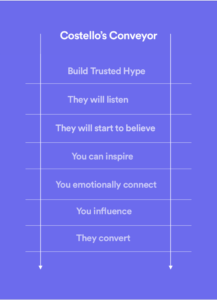
In the second workshop, we were also introduced to Costello’s conveyor belt, which shows how event experiences drive business outcomes. Experiences can’t just be cool; they must bring attendees along on a journey that leads to the business outcomes you desire.

When crafting an event experience, Ryan’s other special guest, Mark Roberts, Head of Experiential at POP Experiential, reverse engineers the whole thing. What does he want attendees (and his client) to think and say as they leave the event? What is their big takeaway from the experience? What quotes does he want to see in the press? He thinks about how he can design an experience that results in those outcomes.

Events (Ho-Hum) vs. Experiences (Wow)

Margaret isn’t trying to put on events. An event is a one-way engagement where content/entertainment is pushed at you. She’s interested in experiences. An experience triggers emotions in a two-way interaction, sparking curiosity and feedback. 

An event is a moment in time, says Mark. An experience lives beyond that specific moment. It lives within the attendee after the event because it created a meaningful, emotional engagement.

Mark says it’s time to break the rules. Experience makers are busting out of proven event formulas. We’re not returning to just physical events, so take advantage of the freedom you have to push the boundaries on experiential marketing, i.e., event experiences. We’re in a hybrid world, which is an opportunity for a broader reach beyond the physical walls of an event, where you can have more collaborators and reach more attendees, and seamlessly integrate the physical and virtual experiences so both audiences feel primary. He sees the experience maker’s goal as giving goosebumps in this virtual space.Event Farm experiential applications (EFx) level-up guest engagement by creating fun and personalized experiences, while capturing invaluable data to measure engagement and ROI.

Inspiration for Big and Low-Budget Event Experiences

With virtual reality, augmented reality, and 3-D technology, you can provide experiences that are more fantastical than real life. Mark talked about an event at a Comicon for the TV series, Mr. Mercedes, where fans could immerse themselves in the TV show’s virtual set. During the event, fans collected clues, unlocked new content and prizes, and took part in a photo experience that transformed their faces into shareable GIFs. 

This experience made attendees feel like they were in a different world, an exclusive world. It gave them technological goosebumps and shareable moments that lived beyond the walls of the physical event.

Sounds great, but who has a budget for that? Here’s the thing: “Wow” doesn’t have to cost a lot of money. Lighting and video projections go a long way. Think “scrappy not crappy,” says Mark. 

Ryan talked about a Charity Water fundraiser where, for a $5K donation, an attendee picked up two heavy jugs of water and walked around the perimeter of the room, emulating the walk taken to water sources by people in villages without clean water. This empathetic experience lands with you. It’s tough to make it around the room without stopping to rest and think about those who have to do this a few times a day.

For fundraising events, Margaret advises focusing on emotions, not money. For example, at a fundraising gala for a youth organization, inspire the attendee to get nostalgic by offering reminders of their childhood. Ask children served by the organization to write notes to attendees about the personal impact of their donations. Encourage people who donate to write back to a child. Trigger emotions and spark new memories.

Ryan recommends a “progressive” event experience. Don’t introduce all your event elements at once. Build a story. Change lighting and videos. Give a sense of a moving, alive experience, not a set-it-and-forget-it experience that feels dull after 20 minutes. You want attendees to feel like they can’t leave because something else might happen. Keep delighting and surprising them over and over again. 

Well-crafted event experiences move people emotionally while also moving them closer to your business goals, whether that’s a pledge/donation, purchase, membership, or a deeper commitment as a fan or advocate. Crafting an event experience for your attendees—a moving, enjoyable, and memorable experience—is more than logistics, it’s an art.

To learn more about how to turn events into safe and engaging experiences with Event Farm, request a demo today.

Read more
23Nov

Crafting the Event Experience: A Guide to Experience Mapping

November 23, 2021 Marketing Team Posts 312

How do you hook the attention of your audience, build their excitement for your event, and design an event experience that exceeds their expectations while delivering the business outcomes you seek? Yes, you can do it all. Our in-house event experience technologist, Ryan Costello, co-founder of Event Farm and Chief Strategy Officer at MemberSuite, shared his trusted technique in our recent event workshop: Crafting the Event Experience – Part 2: Experience Mapping.Missed Part II of Crafting the Event Experience Workshop w. Ryan Costello?Ryan’s method, experience mapping, takes you through the attendee journey, thinking not only about the function of each touchpoint but what emotional response it will evoke too. It helps you stay on track with your goals, especially when team members and stakeholders have lots of “good ideas.”

Move Your Audience Along Costello’s Conveyor

How do you deliver event experiences that drive business outcomes? First, you bring your target audience onto Costello’s Conveyor. This conceptual mechanism moves them from the first attendee touchpoints to conversion (i.e. the outcomes you seek).

This journey starts with your registration website and event invitation—the touchpoints where you build trusted hype. Ryan explained how to do this in Part 1 of our Crafting Event Experience workshop series. Your website and invitation branding express an experience or vibe that resonates with your audience. 

Your branding elements give your audience the feeling that this event might be something they’d value. They decide to listen. Soon, they see you as a credible source and believe you have something compelling to offer.

You inspire them to take the next step: click on a link, share information with others, or register. You’ve emotionally connected with them because they feel you get them and influenced their behavior. 

Ultimately, when you keep your focus on their experience and your objectives, you’ll achieve the desired outcome or conversion—they purchase, join, take away knowledge, develop relationships, or become warm leads for you and/or your sponsors.

How Do You Want to Make Them Feel?

Ask this question at each attendee touchpoint before, during, and after the event. Ryan’s webinar guest, Margaret Launzel-Pennes, CEO of POP Experiential, repeated the planner-like wisdom of Maya Angelou: 

“People will forget what you said, people will forget what you did, but people will never forget how you made them feel.” 

Take your site diagram and go step-by-step through every element of the event experience, thinking not just about the function of those elements (your perspective), but the attendee experience too (their perspective). 

  • Check-in set-up: What music will we play at the entrance? 
  • Trash cans: What do our trash cans look like?
  • Name badges: Can attendees read badges when socially distanced?
  • Conference room lights: Where’s the dimmer and color control?
  • Taking seats before the keynote: How can we engage/excite them when they walk in?
  • PowerPoint decks: Who’s reviewing the design of the speaker presentations?

Ask for each one: “How will it make attendees feel?”

Margaret suggests adopting innovator DNA. Be an anthropologist in your space instead of doing things as you’ve always done them. Step outside your normal comfort zone’s approach. She suggests looking at fashion and music industry events for inspiration, then morphing their big-budget ideas into something that works for you.

Guidelines for Event Experience Mapping

Simultaneously take on the attendee point-of-view while staying aligned with the desired business outcomes for the event. 

When stakeholder agendas arise, trust your gut. Be confident in doing it your way—what’s best for the attendee experience and business outcomes.

Everyone loves suggesting a “cool” or “wow” experience, but these wow factors are good enough on their own. Every experience must move attendees closer to the desired business outcome.

Obey the rule of reciprocity. If you’re getting something from attendees, like information, what is the attendee getting back? If nothing, then it’s not allowed in the experience.

Build Interest and Excitement Before the Event 

With experience mapping in your toolbox, let’s return to the attendee journey. You’ve already set up the registration website and sent invitations. Your marketing campaign pulls the audience along the conveyor. 

Tap into your constituency for marketing and planning insight. For one of her events, Margaret consulted with a diverse group of millennials. Your think tank doesn’t need to be a formal group.

To build hype and instill FOMO, take advantage of the human impulse to share. Give them Instagrammable moments that build their expectations so they arrive at your venue raring to go.

Tease out programming instead of announcing all your speakers or highlights at once. Don’t rehash the same marketing messages over and over. Have something new to say in each email so people are tempted to open them. 

Never resort to “hurry, we’re almost sold out” desperate-sounding messaging. Late registration is normal these days, especially for virtual events, so relax. If you’ve done thorough market research and planning, the people will come.

Use smart email marketing tools so you’re not sending promos to people who already registered.

Experiment with new channels, for example, paid LinkedIn advertising or retargeting. Go beyond your legacy audience to find a new audience awaiting you. 

Share the attendee list so people get excited about who else is going. Everyone is craving community, especially when they’ve been feeling isolated during the pandemic.

Let your audience know they can trust you to provide a safe and enjoyable experience. Share your safety protocols in emails and an FAQ on your website. Use an event app to take care of business (vaccination or negative test validation and health screening questions) before they arrive so they enjoy a smooth check-in process.

Think about the attendee’s experience at the door. What will it feel and look like? Functionally, it’s a safety check, but do you want it to feel like a hospital entrance with people waiting in line for temperature scans? Certainly not. Now that Event Farm is integrated with CLEAR Health Pass, you can use our app to validate vaccinations and negative COVID tests, and ask health screening questions before the event, so attendees enjoy a smoother and quicker check-in.

Learn how our suite of Event Farm safety tools can take care of many essential attendee touchpoints before, during, and after your event. 

Read more
25Oct

20 Pandemic-Related Changes to Make in the Attendee Journey

October 25, 2021 Ryan Costello Posts 129

Event organizers are eager to bring people back together safely. To help attendees feel comfortable and confident about the event experience, put yourself in their shoes so you can understand the event journey from their point of view. Attendees naturally have different expectations now. You must placate their anxieties, answer their questions, and get them excited. 

Your job as an event experience technologist is to map out and consider the intention of each attendee touchpoint from start to finish. Think about what you’re trying to convey and what you hope the attendee experiences at each touchpoint. We’ll take you through 20 touchpoints here, but there are many more—this is just a start to prime your planning.

Registration Touchpoints

The biggest change in registration is the type of information you provide attendees so they know what to expect.

#1: Code of conduct. An agreement on how you expect people—attendees, staff, speakers, exhibitors, etc.—to treat each other is not new. The code of conduct explains how everyone should behave and what happens when they’re non-compliant, for example, not wearing a mask. This code lets attendees know “we’re all in this together.” It gives them the confidence that you’re doing your best to provide a safe environment.

#2: Event FAQ. Attendees expect to see up-to-date information on your safety policies and your plan to deal with the situation as it unfolds. This information helps them to decide whether to attend.

#3: Safety marketing. By marketing your safety tactics in your FAQ, emails, and social posts, you alleviate concerns and give attendees the confidence that the event is safe to attend. 

#4: Refund policy. Refunds are a dealbreaker. If conditions change, people want assurance that they can get a refund. 

#5: Pricing. Attendees balance a desire to participate in your event with the inconvenience of being away from home and the inherent risk of crowded environments while traveling and attending your event. Do you counter with a lower price? Or do you increase the price and reduce the size of the crowd? 

#6: Value. Consider whether your event still offers what attendees used to value about your pre-pandemic event. Or do they value something different now? Is a socially distanced networking experience with fewer people still valuable? 

Pre-event Touchpoints

#7: Vaccination verification, COVID test verification, and health screening. To ensure everyone’s safety, more and more organizers are performing vaccination/test verifications at in-person events. This process must be as simple as possible for attendees. Now that Event Farm is integrated with CLEAR Health Pass, you can use our app to validate vaccinations and negative COVID tests, and ask health screening questions before the event.

#8: Event preparation emails. As the event gets closer, remind attendees about safety policies and urge them to review the FAQ so they know what to do before they arrive and what to expect when they get there.

Check-In Touchpoints

#9: Vaccination verification, COVID test verification, and health screening. Yes, we’re repeating ourselves because some attendees won’t take care of this beforehand, so you’ll have to go through this process at the door. You don’t want the first touchpoint of the day to be burdensome, so leverage technology like Event Farm to streamline the experience.

#10: Waivers. Consider the type of event you are hosting and whether you want to require a waiver. Even though many lawyers believe it’s not defensible, we recommend asking your legal counsel if it is necessary. 

Event Touchpoints

#11: Pandemic Safety Compliance Advisor. The employee or contractor who is certified for this role is in charge of compliance with state and local regulations and any compliance requirements established by your organization, venue, or insurance carrier. The Advisor establishes the safety policies and procedures for the event but leaves the enforcement to your security team. 

#12: Contact tracing. If, after the event, an attendee tests positive for COVID, you want to know where they went and whom they interacted with during the event so you can notify the relevant people instead of every attendee. NFC-powered wearable technology, such as wristbands and badges, can track an attendee’s movement in and out of event checkpoints.

#13: Real-time text messaging. You need an immediate way to communicate with all (or a subset of) attendees about special announcements, safety information, and changes to the program.

#14: Queuing tool. You can use an app like Event Farm to control crowds and stagger queuing anywhere a line forms, like registration/check-in, meet-and-greets, product demos, and food/beverage stations.

#15: Programming tweaks. Let attendees know how you’ve changed various aspects of the event experience because of safety concerns, for example, smaller general sessions and breakouts, or more time for breaks.

#16: Networking comfort levels. When designing the event experience, take into consideration the different comfort levels people have toward networking. Think about creative ways they can signal their willingness for closeness to others. For example, we’ve seen different wristbands or badge colors being used.

#17: Signage. Post signs in appropriate spots as a reminder for attendees to follow social distancing protocol when positioning themselves in line or taking a seat.

#18: Entertainment/F&B. If you’ve changed a program or catering feature that attendees valued in the past, fill that void in a different way. Let attendees know what they can expect this time. 

Post-Event Touchpoints

#19: Emergency messaging. Put a system in place that allows you to notify attendees that, according to your contract tracing tool, they were in the vicinity of someone who tested positive for COVID.

#20: Compliance reporting. If your organization has to document vaccination/test verifications and health screenings, use a tool like Event Farm Check-In and CLEAR Health Pass as a reporting system. 

We’re stopping at 20, but there are many more touchpoints in the attendee journey—meal packing, seating arrangements, table locations, exhibit booths, ventilation mapping—the list could go on and on. The sweet spot is finding the balance between providing an enjoyable attendee experience and giving them the confidence that you’re looking out for their safety.

Learn how Event Farm safety tools can take care of many of these essential touchpoints before, during, and after your event. 

Read more
  • 12345
logo_eventfarm001

About Event Farm

Event Farm is a toolset of event engagement applications designed to promote brands and engage targeted audiences at in-person, virtual, and hybrid events.

Solutions

  • Registration
  • Check-In
  • Engagement
  • Attendee App
  • Exhibitor Experience
  • Zoom
  • Event Safety

Company

  • Pricing
  • Request Demo
  • Blog
  • Resources
  • Careers
  • Partners
  • Press & Media

Support

  • Event Farm Log-In
  • Support Knowledge Base
  • Platform Status
  • Contact Support
  • Contact Sales: sales@eventfarm.com
  • Email Us: hello@eventfarm.com
  • Legal Terms

Privacy Policy | Legal Terms | Terms of Service

©2024 JRNI. All Rights Reserved

in